Photo Editing With: A Beautiful Mess App

IMG_0983

With graduate school ending in two weeks, I have been thinking about how important this blog has become to me.  I started Scissors & Sage back in September, hoping that it would help keep me sane during what would be a hectic and probably stressful school year.  I wasn’t sure if I’d be able to keep up with writing posts once a week, but as it turns out, I have largely stuck to my goal.  In music therapy, I often hear and learn about the benefits of self care, and this blog has certainly done the trick so far.

As my nostalgia has been kicking into high gear this month, I thought I’d take some of my Instagram photos and do something fun with them.  I’ve been exploring the A Beautiful Mess iPhone app a lot recently, experimenting with different ways to alter photographs specifically with text.  Above and below are some examples of what I’ve been working on.  There are so many ways to alter photos in the ABM app that these photos just skim the surface.  I am excited to keep trying out new designs and ideas!

IMG_7092 IMG_0876 IMG_0990 IMG_0991 IMG_0992 IMG_1140 IMG_1141

Container Gardening With: Ellen Drews

Today’s blog post comes from a dear friend, Ellen Drews.  Ellen is a banjo-playing, bug-loving, and plant-praising kind of gal.  She has recently moved to the Boston area, and has hit the ground running managing several community gardens.  From Ellen:

As a resident of densely-populated Somerville, Massachusetts, and a manager of three community gardens in Lowell, I have been putting a lot of brain power towards the challenge of growing delicious, seasonal vegetables in places with contaminated soil—or no soil at all! In my opinion, no one should have to pass up the fun and tasty rewards of vegetable gardening just for lack of workable land. So why not grow food above the land—in containers! Well, that’s what I did in the parking area behind my apartment. And my landlord keeps telling me he can’t wait until “we” are reaping the bounty.   I guess he’s expecting me to share.

farm

Container gardening offers many benefits: soil in containers warms up earlier in the spring, so you can plant those heat-loving tomatoes, peppers, and basil a bit earlier than you could in the ground. Containers can be put in locations with ideal sun exposure. And containers offer less territory for weeds and pests to take up residence—often resulting in healthier plants.

There are also a couple of limitations that container gardening brings that are important to be aware of:

  1. Vegetables grown in containers cannot spread their roots very far to find the perfect mix of nutrients in the surrounding soil. Everything they need must be present right there in that compact space. Therefore, it’s necessary to fertilize your containers a few times during the growing season with yummy compost or organic fertilizers.
  2. Soil in containers dries out easily, especially if the container has the proper drainage it needs to avoid root fungus. Dry soil is of no use to a growing plant—the plant requires water to exchange nutrients at the roots. What’s more, if a young vegetable seedling goes through the stresses of repeated “droughts” or under-watering, it will never reach its full potential!

But some of us have day jobs—so how can we keep our containers at the perfect, constant moisture level without running outside to water them every few hours? Easy! Build self-watering containers.

Self-watering containers are somewhat misnamed. They don’t water themselves infinitely—you will still have to go out and water your plants every couple days to every day on hot, dry days. However, wicking action will draw water through the soil from a reservoir below and will reduce major moisture fluctuations in the container. Your job is to make sure that the reservoir always has some water in it, and the container will do the rest! You can buy self-watering planters, but DIY containers are easy to make and much cheaper.

Self-Watering Container Garden

Materials:

  • 2 five-gallon food-grade plastic buckets (available at hardware stores, or for free at many restaurants!)
  • 4-6” piece of PVC pipe or PVC fence post
  • Drill and drill bits (1/4” bits work best – anything on the larger side is good for making drainage holes)
  • X-acto knife or sharp clippers
  • Sharpie marker
  • Organic potting soil (if it contains compost, great! If not, get some granular fertilizer like PRO-GRO to mix in for nutrients. I used Coast of Maine organic container soil.)
  • Seeds or seedlings of your favorite veggies (look for varieties like “compact” or “bush”)

What to do:

  1. Start with one bucket—this one will be nested inside the other, and will hold the soil and your plants. Turn it over and use the drill to cut out a big circle in the bottom of the bucket. You may need to use the X-acto knife or clippers to fully punch out this circle.
  2. Then, drill about a dozen “air holes” randomly throughout the bottom of the bucket. These holes will allow air to penetrate the soil and will drain excess water into the reservoir bucket below.
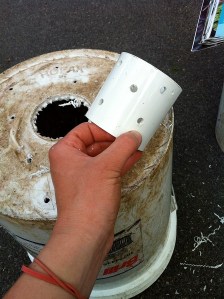
PVC spacer

  1. The piece of PVC pipe or fence post will serve as a “spacer” between the two buckets, holding them apart and also forming the “wick” part of the container where garden soil comes in contact with the water in the reservoir. Drill several holes throughout the PVC spacer, making sure that about 4-5 of the holes are within a 1/4” from the bottom edge of the spacer. This way, it will be able to draw water, even if the reservoir level is fairly low.
  2. Position the spacer in the middle of the second (hole-free) bucket and nest the other bucket on top of the spacer. Mark where the bottom edge of the inner bucket reaches with a Sharpie on the outer bucket. Drill out a hole that meets the edge of the inner bucket about 2” across and 1” tall. This will be your access point for re-filling the reservoir and for checking the water level with a finger!
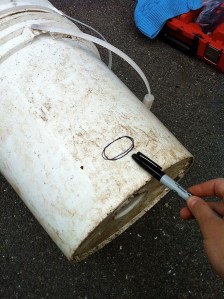
sharpie mark

  1. Remove the inner bucket and fill the PVC spacer with potting soil. Pack it gently to remove any large air pockets, but don’t compress the soil too tightly. The spaces between the soil particles will allow water to wick through the spacer and up into the soil of the inner container.
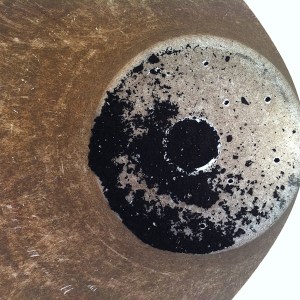
inside bucket

  1. Nest the inner bucket over the spacer so that the circular hole in the bottom lines up with the PVC spacer. Fill the inner bucket with potting soil.   The soil inside the bucket should be making direct contact with the soil in the spacer, so that it forms a continuous wick throughout the bucket. Fill to within an inch of the top rim of the bucket—you want your plants to have as much soil as possible in the limited space so don’t skimp out on filling up the bucket.
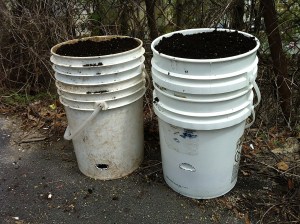
finsihed containers

  1. Water the soil until it starts to drain into the reservoir below, then fill the reservoir using the side access hole in the bottom bucket. Now you are ready to tuck in some seeds or some seedlings and watch them grow!
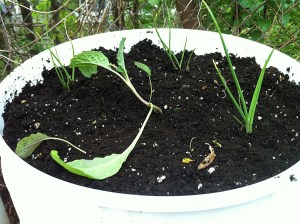
kale scallions

I’m growing kale and scallions in one self-watering container, and I’ll put a tomato plant into the other container, now that we’ve passed the last frost date for Boston.   I’ve also got beets, arugula, lettuce, and nasturtiums growing in other found containers like a milk crate and a Coca Cola rack. What else can you turn into a container for gardening?  -Ellen (with a slug)

200178_10200213471923016_350974881_n

Note: All photos were taken by Ellen Drews.

Honey Citrus Hand Scrub

IMG_0916

Our skin is the largest organ in the human body and it’s seriously got its work cut out for it.  Skin protects our bodies from infections and prevents us from getting sick.  According to KidsHealth.org, it also “keeps your insides from falling out,” which is definitely an added bonus.

Our hands do a lot of things for us, like cook, shake hands, tend a garden patch, craft, hold babies or pets or cell phones, or scratch that terribly itchy itch.  Why not show them some love?  This hand scrub exfoliates, moisturizes, and leaves your hands smelling great!

Honey Citrus Hand Scrub (Adapted from Lovesome Blog)

  • 1 tsp honey
  • 1-2 tbs olive oil
  • 1-2 tbs fresh-squeezed grapefruit juice
  • 1 cup sugar
  • 2 tsp grapefruit zest
  1. Place the sugar in a medium bowl and set aside.
  2. In a small bowl, combine honey, olive oil, and grapefruit juice.  When mixed, add these ingredients to sugar.
  3. Add in the grapefruit zest, and stir until fully incorporated.
  4. If the scrub is too dry, add 1/2 tsp of olive oil at a time.  If it is too wet, add 1/4 cup of sugar.

IMG_0899

Here’s a bit more information on each of the ingredients:

Honey

Honey is great for a few reasons.  While it’s known to moisturize skin, it also has antibacterial and antioxidant properties!  It works well for any skin type, and is sure to leave your skin feeling terrific.

Olive Oil

Olive oil is an important ingredient here.  Maybe this is my Italian talking, but olive oil is great for skin, hair, nails, and diet.  It helps lock in moisture, and is high in vitamins A and E.  Olive oil can also protect sensitive skin from sun damage.

Grapefruit Juice/Zest

Adding grapefruit to your diet (and hand scrub!) will help your body both inside and out.  It helps flush toxins from your body and skin cells, leading to healthier skin.  Grapefruit juice has vitamins and minerals that can help even skin tone and gently cleanse the skin.

Sugar

Sugar acts as the exfoliator in this recipe, and it certainly does its job.  The nice part is that it can be found in most pantries and is relatively inexpensive.

IMG_0906IMG_0935

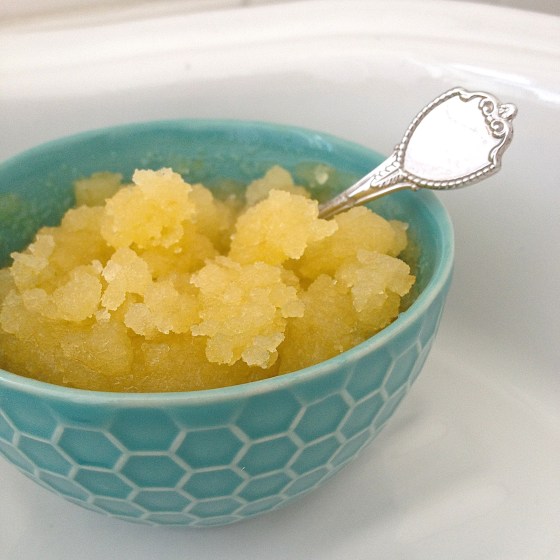
The above picture is from a few days after I made my scrub.  It crystallized nicely from the honey, and has a coarse texture.  Happy crafting!

Mother’s Day Card Crafting

IMG_3794

With Mother’s Day around the corner, I thought I’d share a card I made for my mom last year.  I tried to think outside of the box on this one, adding dimension with the twine and paper banner.  When I was little, I spent a lot of time picking wildflowers from the front yard, making tiny bouquets for my mom.  I wanted to remind her of those days with this card!

But do you want to know the secret “ingredient”?  I stamped the wildflowers with BRUSSELS SPROUTS!  It worked like magic.  All I had to do was cut the sprouts in half and dab them in an ink pad.  I stamped the yellow flowers first, and then the purple.  Next, I adhered the twine with Elmer’s glue.  The last step was to cut out a paper banner to write “happy mother’s day” on.  I decided to make a matching envelope, so I added a white circular sticker and stamped a few more wildflowers on the label.

Who knew you could find a creative use for Brussels sprouts?  I wonder what else is hiding in my refrigerator…

IMG_3786 IMG_3789

Birthday Cake Bunting

IMG_9808

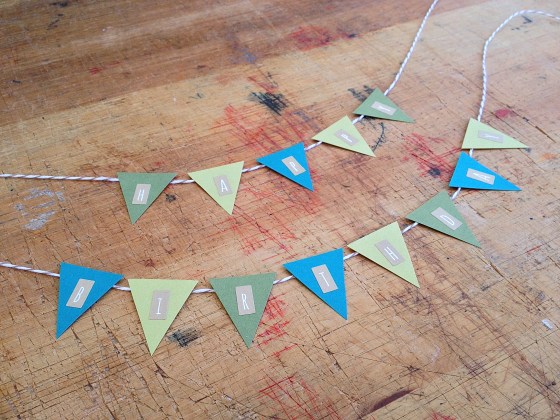
Recently, a couple of friends and I got together to whip up a mean birthday cake for a friend’s party.  We made a chocolate-hazelnut-avocado vegan cake, and needless to say it was a show-stopper.  Although, if my Italian grandmother were to have anything to say about baking (and cooking), it would be this: “If it doesn’t look good, it doesn’t matter what it tastes like.”  Perhaps a bit severe, but I, too, believe that presentation is everything.  That’s why crafting is so fun!  I decided to make a paper bunting banner for this cake, well, just because.  It was relatively easy to make, and I was really happy with how it turned out.

Materials:

  • Tape
  • String
  • Scissors
  • Colored paper
  • Letter stickers or stamps
  • Wooden barbecue skewers

How-To:

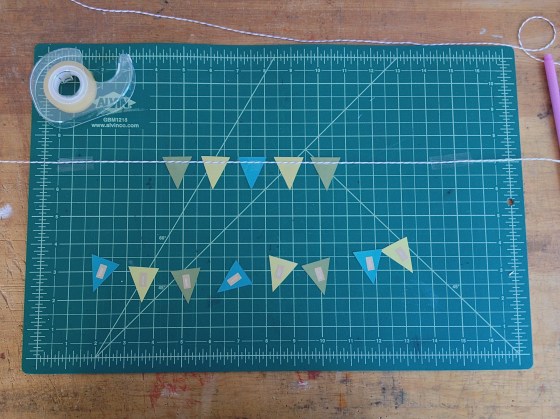
  1. Decide what you want your banner to say, and cut out the correct number of triangles (I used 13 triangles to spell “Happy Birthday”).  Then, cut two pieces of string about two feet long each.
  2. Turn the triangles over, and place the string across the back of them.  Lay down tiny pieces of tape to adhere the triangles to the string.
  3. Flip the triangles right side up, and either add letter stickers or letter stamps to the triangles.  Anne found these letter stickers from the dollar section of Target, and I love them.

IMG_9795IMG_9798

Once the banner is made, find two wooden barbecue skewers (perhaps also from Target).  Lay the skewers down on your work surface, pointy ends toward you.  Gather the ends of the bunting string and either make a knot or a bow with the string around the top end of the skewers.  It might help to also use tape to secure the string.  Hold up the finished product to make sure that the bunting doesn’t hang too low, and make any adjustments needed.  One the cake is made, stick the pointy ends of the skewers into the cake, and voila!  Just be sure that there is a bit of space between the paper bunting and the birthday candles.  That would really do you in in terms of presentation!

IMG_9800